
In about a day and a half of early February 2026, the Sun recorded unusually intense activity. According to space weather monitors, the central star of the Solar System has emitted at least 18 M-level flares and three X-level flares - the strongest group in the solar storm scale.
Most notably is the X8.3, which is currently considered the strongest solar flare of 2026 to date.
The entire series of intense activities originates from the AR4366 black spot area, a large area on the surface of the Sun. Spaceweather.com calls it a "solar storm factory", and warns that this area still has enough energy to continue creating strong outbreaks in the near future.
The X8.3 outbreak peaked at 18:57 (Eastern US time) on February 1. 2. This giant "lighter" releases a large amount of ultraviolet radiation and X-rays, strong enough to disrupt the upper layers of the Earth's atmosphere.
In an official announcement, NASA said that the Sun has emitted 4 strong eruptions in two days, February 1st and February 2nd, with different timelines, classified as X1.0, X8.1, X2.8 and X1.6 respectively.
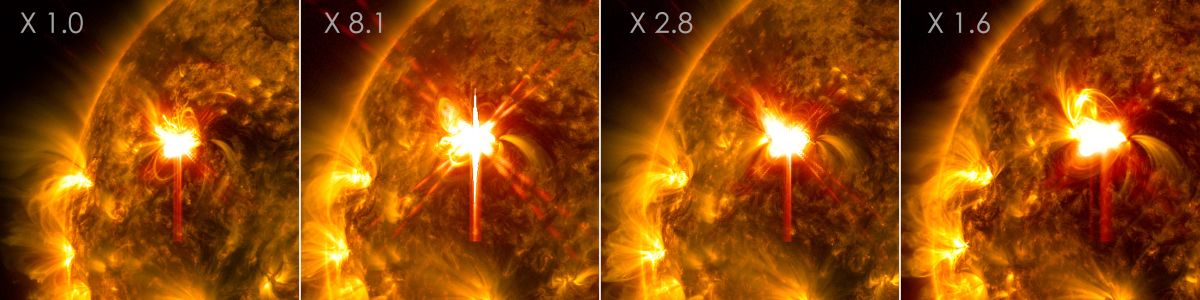
The immediate consequence of the solar storm is loss of R3 level radio communication in some areas of the South Pacific.
The Center for Space Weather Forecasting of the US National Oceanic and Atmospheric Administration (NOAA) confirmed that short-frequency radio waves have been disrupted in eastern Australia and New Zealand, affecting air and maritime communications in a short time.
Scientists are currently closely monitoring the possibility that these eruptions are accompanied by coronal mass (CME) - giant plasma and magnetic field clouds flying into space.
Initial analysis shows that CME is related to the X8. 3 event mainly skewed to the north and east of the Earth. If there is an impact, it is likely just a "light glitch" around February 5, causing a short-term increase in geomagnetic activity.
In that scenario, auroras may appear at lower latitudes than normal.
Notably, the AR4366 black spot area is still continuing to rotate towards Earth, meaning the possibility of further outbreaks in a more direct direction is possible. NOAA warns that this area is likely to cause more notable space weather spells in the next few days.
According to NASA, solar storms are extremely strong radiation eruptions. This radiation does not penetrate the atmosphere to directly harm humans, but when it is strong enough, it can disrupt the atmosphere where GPS signals and communications pass through.
Solar storms are ranked in scales: A, B, C (weak) - M (average) - X (strongest). Each level is about 10 times stronger than the previous level. The number after the letter X indicates the specific intensity, and with X8.3, this is one of the "strongest blows" that the Sun can deliver.


