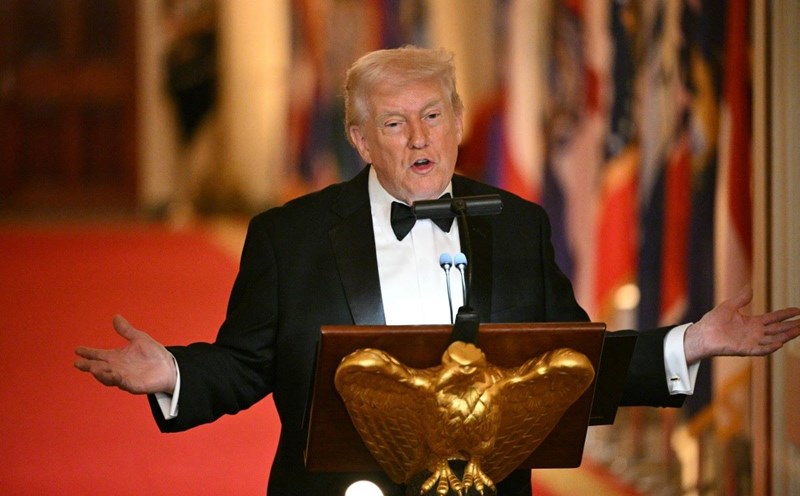
This move comes as US President Donald Trump has repeatedly mentioned the possibility of the US "possessing" Greenland after returning to the White House.
On March 2, the Canadian Department of Natural Resources said that Canada and Greenland had signed a Joint Statement on their intention to cooperate in the fields of strategic minerals and energy. The document was signed between the Canadian Department of Natural Resources and the Department of Business, Mineral Resources, Energy, Justice and Gender Equality of Greenland.
According to published information, the two sides affirmed that cooperation is based on principles of cooperation and mutual benefit, towards strengthening the supply chain of important minerals as well as developing potential energy sectors in the Arctic region.
Greenland is an autonomous territory belonging to Denmark, assessed as rich in strategic mineral resources such as rare earths, uranium and many essential metals for the green energy transition process. Meanwhile, Canada is also one of the countries with large reserves of important minerals, especially serving the production of batteries, electric vehicles and high technology.
This signing move is seen as the next step in the process of deepening bilateral relations, after Canada officially opened a Consulate in Nuuk - the capital of Greenland - on February 6. The establishment of a direct diplomatic presence in Nuuk shows that Ottawa values the increasing strategic role of the world's largest island in the security and economic picture of the Arctic region.
The agreement was signed in the context that the region is witnessing remarkable geopolitical movements. Since returning to the White House in early 2025, US President Donald Trump has repeatedly stated that the US should "buy" or take over Greenland. He even declared that he does not rule out the possibility of using military measures to ensure control of the island.
These statements sparked reactions from both Copenhagen and Nuuk. The Danish government affirmed that Greenland is not for sale, while the Greenland government reiterated the right to self-determination of the people on the island. Canada also publicly expressed support for Denmark and Greenland in response to statements from Washington.
Observers believe that Canada's promotion of direct cooperation with Greenland is not only of economic significance but also reflects a clear political message: Strengthening links between countries and territories in the Arctic based on international law and respect for sovereignty.
In the context of fierce global competition for strategic mineral supply - a key factor for energy transition and high-tech development, Greenland emerges as a new "hot spot". Ice melting due to climate change also makes access to resources and Arctic shipping routes more feasible, and entails many strategic calculations.
The Canada-Greenland joint statement is therefore not simply an economic cooperation agreement. It reflects the repositioning of interests in the Arctic, where resources, security and geopolitics are intertwined more closely than ever.