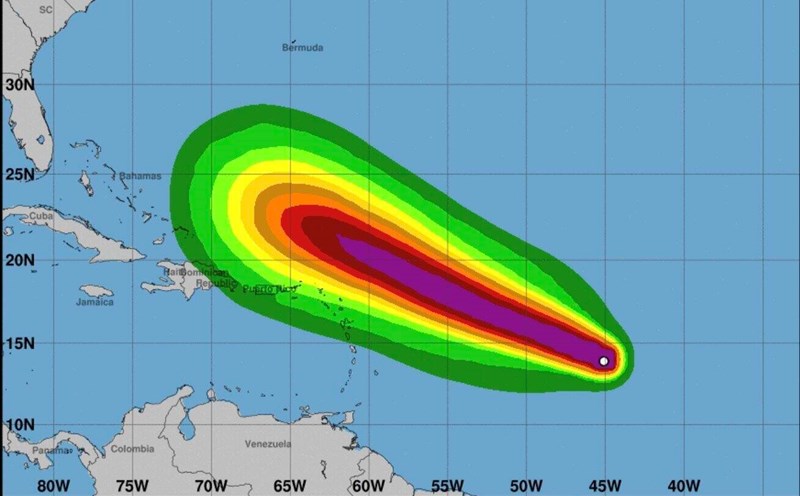
Fox News' latest hurricane report says the 2025 eastern Pacific hurricane season starts on May 15 and runs through November 30.
The first named storm of the eastern Pacific hurricane season will be Alvin, followed by Barbara, Cosme and Dalila.
However, hurricane models show no signs of a storm or tropical depression forming in the near future.
According to statistics from the US National Hurricane Center, the first named storm in the eastern Pacific will average form around June 10 and the first hurricane will develop on June 26.
Forecasters expect the eastern Pacific to see an above-average, much stronger season this year than the 2024 typhoon season.
Last year, the basin had 13 named storms, four hurricanes, and three major hurricanes.
An average season in the eastern Pacific typically has 18 named storms, 10 hurricanes, and four major hurricanes, posing many threats to the Gulf Coast of Mexico.
The status of Southern fluctuations - El Nino, abbreviated as ENSO, plays a decisive role in the development of the storm season in the eastern Pacific.
Currently, the world is in the ENSO neutral stage, meaning there is no La Nina or El Nino phenomenon. A neutral state means that sea temperatures in the central and eastern Pacific will remain at a minimum.
Fox News forecasters point out that while there will be no storms or tropical depressions in the Pacific Ocean in mid-May, the region could provide clues for what is coming, especially in the Atlantic basin.
Traditionally, La Nina seasons form earlier in the eastern Pacific, while El Nino years typically start later.
In ENSO neutral years like this year, the development of the storm season is very diverse: The start of the season is fierce or there are still no storms in the middle of the season.
Understanding how atmospheric models are developing is important, as there is often an inverted relationship between storm activity in the eastern Pacific and the Atlantic basin, weather experts note. When one basin is active, the other basin tends to be calmer due to many factors of the atmosphere and ocean.
Major storms in the Pacific Ocean could lead to opposite-handed waves and upper vertical wind shear in some parts of the Atlantic basin. Wind shear could hinder the formation of depressions and storms in the Caribbean and Gulf of Mexico, leading to fewer storms forming in the area.
Storms can be formed all year round in all basins around the world. However, there are times when the year is more favorable for the development of the storm. In the Eastern Pacific, the stormy season began on May 15. In the Atlantic, the stormy season began on June 1.6. The storm season in both basins lasts until November 30.