
On September 17, Politburo Member, Standing Deputy Prime Minister Pham Gia Tuc led the Vietnamese delegation to attend the Opening Ceremony of the China - ASEAN Fair (CAEXPO) and the 23rd China - ASEAN Trade and Investment Summit (CABIS) in 2026.
Speaking at the opening ceremony, Standing Deputy Prime Minister Pham Gia Tuc said that in nearly 4 decades, ASEAN - China relations have proven to be one of the most successful and stable cooperation models.
In the overall ASEAN-China relationship, Vietnam-China trade and investment cooperation contributes strong momentum and plays an important role in connecting markets and production chains.
Substantive cooperation in various fields has achieved many positive progress, China's investment in Vietnam ranks 6th out of 153 countries and territories investing in Vietnam. Vietnam wishes to continue to contribute more to expanding the ASEAN - China cooperation space, for common prosperity.
The fact that CAEXPO and CABIS this year put ACFTA with artificial intelligence (AI), digital economy, green economy, logistics and supply chains at the center shows that China-ASEAN cooperation is opening up a new step: from market connection to development capacity connection; from traditional goods exchange to digital trade promotion and high-tech investment.
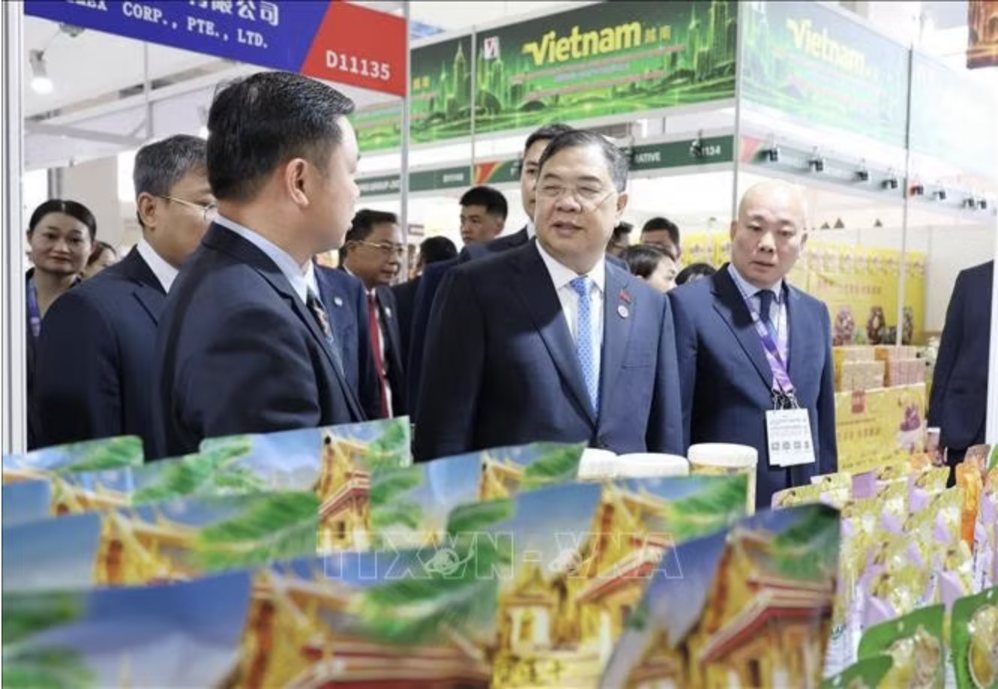
Standing Deputy Prime Minister Pham Gia Tuc affirmed that Vietnam always values, supports and is proud to be an active member contributing to the overall success of the CAEXPO and CABIS Fairs. At this fair, Vietnam has 120 participating businesses, more than 200 booths with many diverse and rich products.
On this occasion, Standing Deputy Prime Minister Pham Gia Tuc emphasized 4 cooperation proposals:
First, bring ACFTA 3.0 truly into life; simplify procedures, facilitate trade and investment; further expand markets for each other's goods.
Second, promote ASEAN - China trade and investment in a balanced and sustainable direction; strengthen linkages between businesses of the two sides in green agriculture, clean energy and new fields.
Third, promote digital connection and innovation; jointly exploit the potential and effectively use AI, cross-border e-commerce, digital infrastructure and smart logistics, together promote the innovative, safe and inclusive regional digital ecosystem.
Fourth, strengthen ASEAN-China infrastructure connectivity in terms of roads, railways, sea and aviation, especially cross-border transport connectivity, logistics and economic corridors, thereby forming a stable and highly efficient regional supply chain.


