
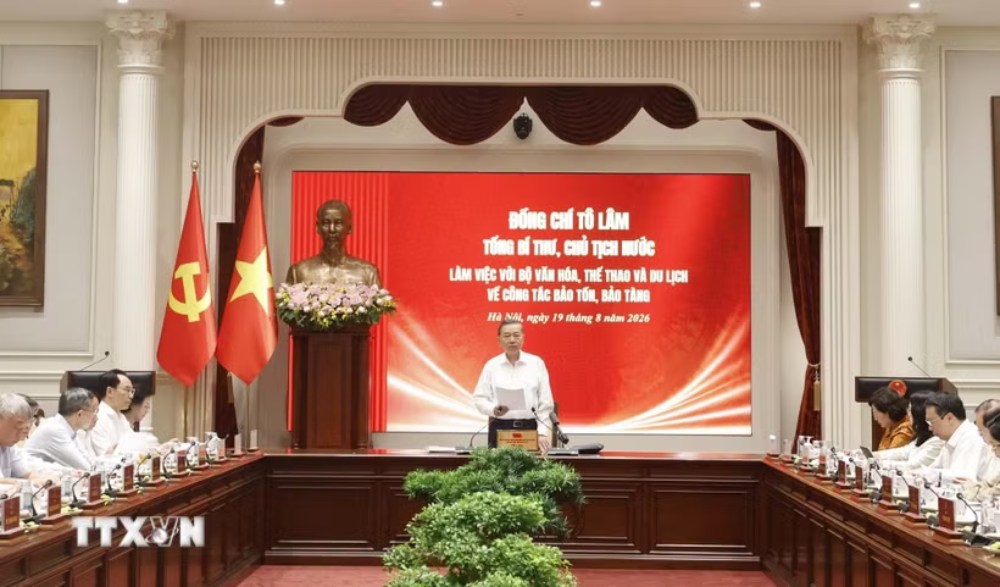
On the afternoon of August 19, in Hanoi, General Secretary and President To Lam worked with the Ministry of Culture, Sports and Tourism on conservation and museum work, according to VNA.
According to a report by the Ministry of Culture, Sports and Tourism, currently, the whole country has more than 40,000 relics and about nearly 70,000 intangible cultural heritages inventoried.
The whole country has 20,060 artifacts and antiques registered according to the provisions of the Law on Cultural Heritage, 177 museums, preserving and displaying over 4 million documents and artifacts, including many collections and particularly rare artifacts; 1,881 artisans have been awarded the titles of People's Artisan, Meritorious Artisan.
After listening to the report and exchanged opinions, speaking at the working session, General Secretary and President To Lam requested to seriously review the constructive capacity and structure of the conservation and museum system; and at the same time thoroughly handle inadequacies, prolonged projects and gradually enrich national collections.
The Ministry of Culture, Sports and Tourism must complete the preliminary review step, identify urgent issues; must have an overall report, clearly identify the priority list and handling plan for each group of issues.
The review should include the status of relics, the level of degradation of operating facilities and the order of investment priorities; avoid minor repairs, prolonged patchwork, and multiple investments that ultimately do not fundamentally solve the problem.
The General Secretary and President noted that it is necessary to overcome the gaps in preserving Vietnamese history from the time the country gained independence to now, especially the history of the process of building, developing and transforming society; it is necessary to form the capacity to identify and create future heritage right from the time those values begin to be formed.
The responsibility of today's generation is not only to protect what our ancestors left behind, but also to seriously think about what we will leave behind for hundreds, thousands of years and forever after.
This is a shift from passive preservation to proactively creating national memory, in which each generation not only receives what the past has left behind, but also has the responsibility to create and preserve values that can become the heritage of the country for hundreds, thousands of years to come.
The General Secretary and President clearly stated that historical, cultural and heritage data must be considered a core part of the national cultural infrastructure.
Establish a national digital cultural data warehouse in a unified, interconnected, verifiable and long-term use direction.
Have specific and superior institutions and policies to develop data and artificial intelligence in protecting, preserving, and transforming cultural values into economic values to develop the cultural industry; must immediately solve the long-term digital preservation problem...
The General Secretary and President noted that practice shows that museums with good content, good storytelling, good space and good experiences can still attract millions of visitors each year. This proves that the public is not far from museums, the question is whether museums really create value for the public to come to or not.
The General Secretary and President reminded the Ministry of Culture, Sports and Tourism to innovate the way of evaluating the effectiveness of museum activities; it is necessary to measure how many people come, who comes, whether young people come, whether they return, what impact educational activities create, what research contributes, how data is exploited and what society receives back from the state's invested resources.
The Ministry of Education and Training must coordinate to make the museum a regular learning space, because history and culture, if only conveyed through books, can hardly create a deep connection by seeing real artifacts, real spaces and real stories.


