
The above content was mentioned by General Secretary To Lam at the meeting with voters in Hanoi after the 10th Session of the 15th National Assembly, held on December 15.
Referring to the results of the two-level local government after 5 months of operation, the General Secretary said that this model is stable and smooth, and the initial difficulties and problems have been identified.
These difficulties are also being focused on by agencies, especially issues related to the arrangement of professional staff, arrangement of headquarters, regimes, means, policies, and settlement of administrative procedures.
"The Central Government and the Government are continuing to urge the progress of arranging public service units, medical and educational facilities and improving the quality of activities of communes and wards because this is the most important level, close to life, solving all problems of the people.
How should we do so that the people do not have to go to the provinces, not the central government. The ward and commune levels must be responsible for solving this problem, not blaming it on superiors," said the General Secretary.
According to the General Secretary, wherever there are opinions and complaints, the ward and commune must take responsibility. If it exceeds their authority, the authorities of wards and communes must report to superiors, the city, and the Central Government.
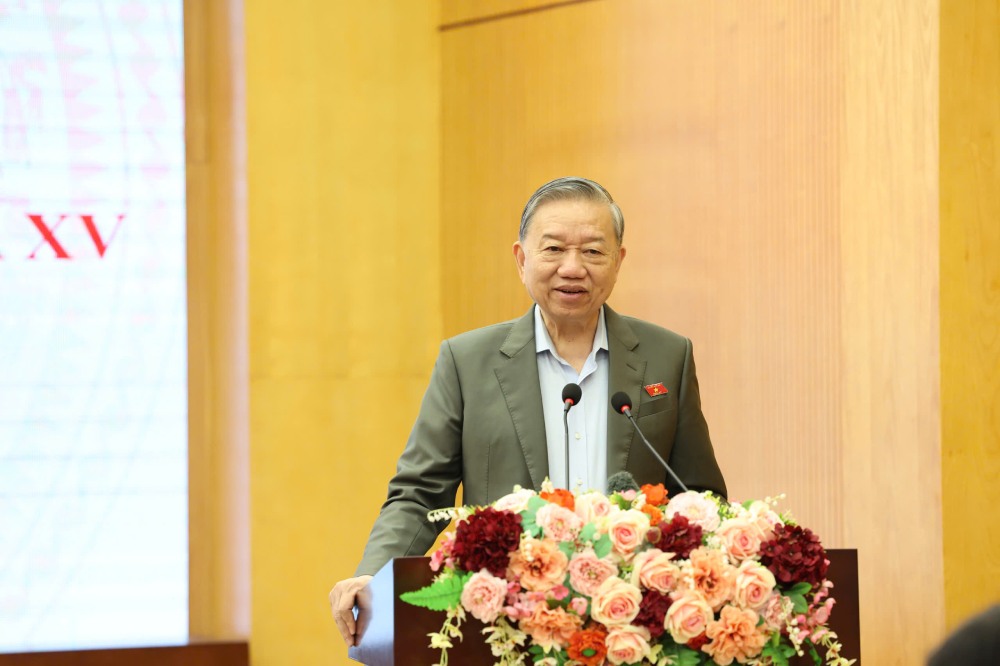
In response to voters' reflection on the overload of hospitals, the General Secretary suggested that Hanoi and the Ministry of Health resolutely implement Resolution No. 72 of the Politburo "On a number of breakthrough solutions to strengthen the protection, care and improvement of people's health", including exemption of hospital fees.
The General Secretary explained that hospital fee exemption is exemption of basic medical services in health insurance and increase hospital fee exemption for people. The orientation will be to increase the rate of people with insurance and expand the list of health insurance payments.
How should people assess their health "early and from afar", if there is cancer, it must be in the early stages, then prevent infectious diseases.
Therefore, it is necessary to improve the quality of grassroots health care and continue to invest in city hospitals. The new serious disease has reached the upper level, and regular check-ups are at the grassroots level. People will have a general health check-up at least once a year.
"There are people aged 70 and 80 who have never been examined and treated at one time, have never had their blood pressure measured... Only when the pain is no longer unbearable will they be taken to the hospital, it will be too late," the General Secretary shared.
Regarding education, the General Secretary requested Hanoi to fully invest in facilities, ensuring spacious, safe and modern schools; promoting digital transformation, reducing procedures, and reducing administrative pressure on teachers and parents.
With a number of suspended projects, unsynchronized digital infrastructure, and disaster forecast information, the General Secretary emphasized that Hanoi needs to classify and completely handle suspended projects; speed up the renovation of old apartment buildings, especially dangerous areas; invest heavily in digital transformation, data infrastructure; perfect the disaster warning system, proactively respond to climate change.
"These are problems that have lasted for many years, directly affecting people's lives. I suggest that the city identify this as a key task, need a clear roadmap, have someone responsible and report the implementation results to voters on each specific issue," said the General Secretary.


