
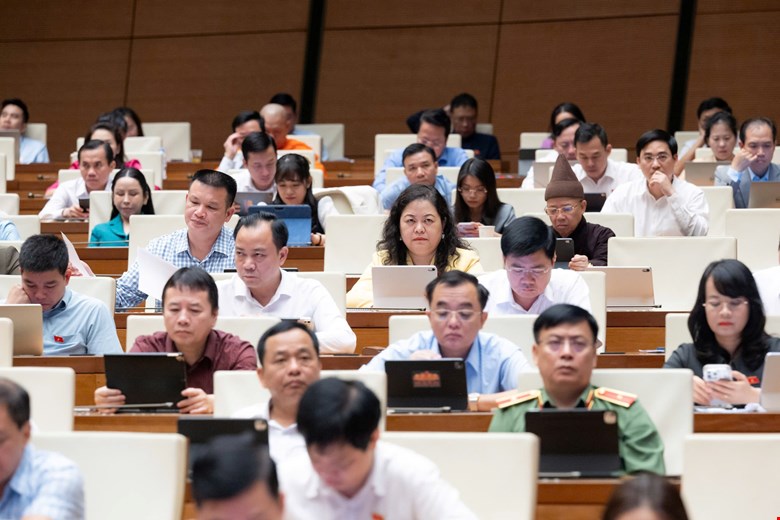
Discussing at the National Assembly on the draft Resolution of the National Assembly on a number of breakthrough mechanisms and policies for Vietnamese cultural development on April 22, delegate Tran Thi Dieu Thuy - Deputy Head of the Ho Chi Minh City National Assembly Delegation (Vice Chairman of Ho Chi Minh City People's Committee) - agreed with the breakthrough contents in the draft resolution.
According to the delegate, according to Resolution 105/NQ-CP of the Government on continuing to build and complete the organizational structure, there are orientations for arranging public service units in the fields of culture, sports and tourism.
In which, the provincial level arranges in the direction of no more than 7 public non-business units providing public non-business services corresponding to 7 fields including museums, libraries, art performances, culture and sports, tourism promotion, relic management, gifted high schools, cultural and artistic tourism secondary schools (if any). In which assigning one unit to serve state management (if any).
At the commune level, the commune-level People's Committee decides to establish public non-business units providing basic essential public non-business services in many industries and fields including culture, sports, tourism, information, communication, environment, agricultural extension, urban areas... on the basis of existing public non-business units providing basic essential public non-business services.
The delegate said that Ho Chi Minh City has established 168 public service supply centers corresponding to 168 communes and wards. However, many units have not been put into operation because they have not been allocated facilities as well as have not received financial guarantees and inherited grassroots cultural institutions.
These centers mostly meet standards but are scattered, not located in the centers of communes, in some places the area is narrow and degraded. The main personnel force performs administrative work, lacking personnel directly with professional expertise in culture and sports.
The financial mechanism is mostly autonomous group 2, group 3, and the rest is group 4, only meeting salary payments, without revenue sources for reinvestment. Socialization is facing difficulties due to the lack of a legal framework and the legal status of commune-level centers is not clear.
Meanwhile, cultural institutions previously under the district and commune levels such as cultural and sports centers, children's houses, and ward and commune cultural houses have all been rearranged, no longer having functions and tasks according to groups of subjects.
In particular, the district-level children's house facility, which previously proved to be effective as a place to nurture, discover, train, and provide cultural and artistic human resources for children at the grassroots level, is now also no longer functioning.
To solve this problem, the delegate proposed to add regulations on establishing multi-functional units to replace all previously dissolved institutions, including cultural centers, children's houses, ward activity points, etc., no longer included in the number of non-business units.
There are new management model solutions for arranged units, ensuring financial autonomy, organizational structure, facilities, branches, and branches of each group of units such as the model of children's cultural centers, cultural and sports centers, central museums, and satellite museums.
At the same time, there should be flexible financial policies for localities in difficult areas that cannot have guaranteed revenue from socialized sources.


