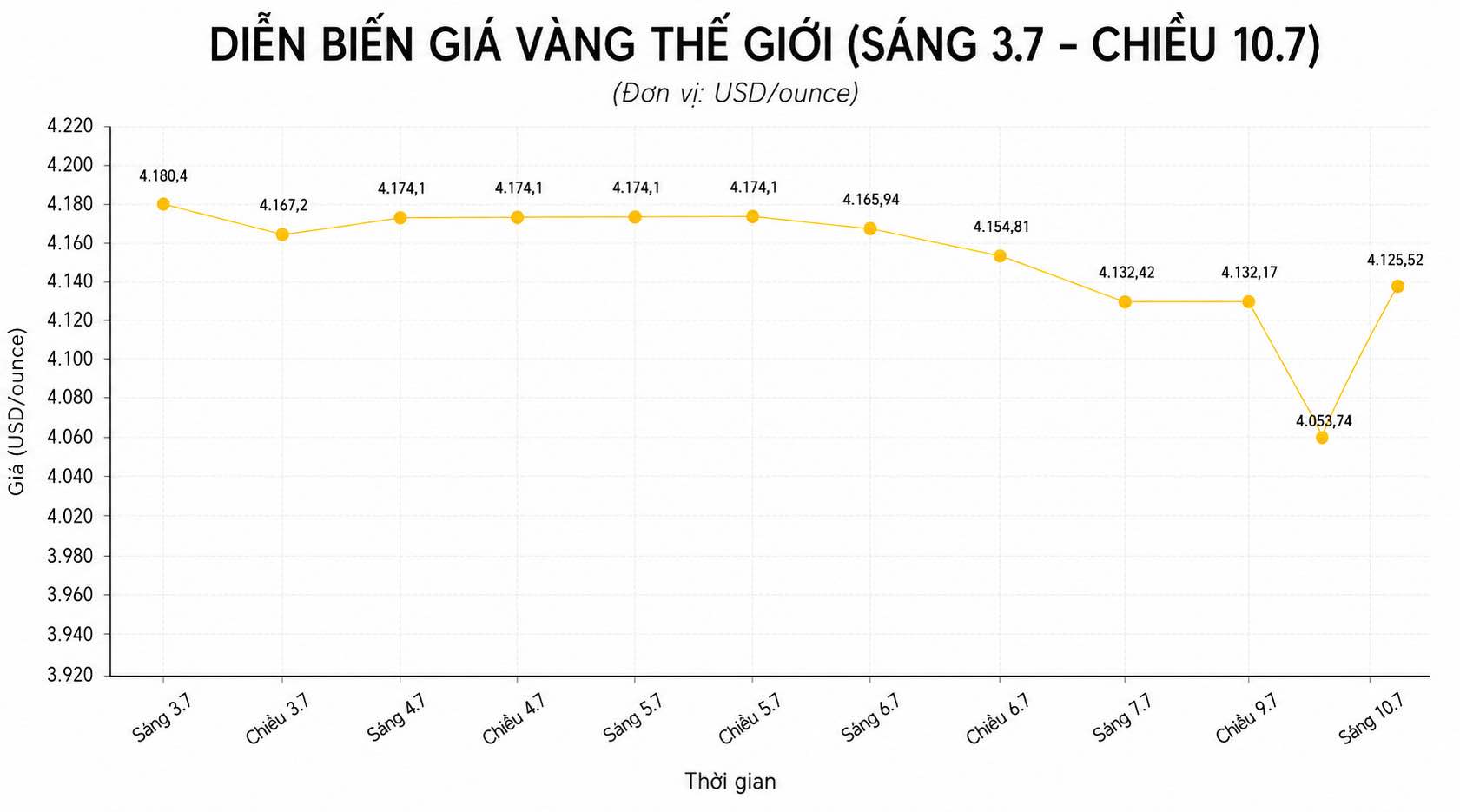
World gold prices recovered in the trading session on July 10 after three consecutive declining sessions, as the USD and US bond yields cooled down. However, the outlook for the precious metal is still under pressure from the risk of the US Federal Reserve (Fed) maintaining high interest rates amid escalating tensions between the US and Iran.
As of 07:56 am Vietnam time, spot gold price increased by 1.3% to 4,125.52 USD/ounce, after three consecutive declining sessions. On the precious metals market, silver price increased by 0.53% to 60.27 USD/ounce, while platinum and palladium both recorded increases. Meanwhile, the Bloomberg Dollar Spot Index, measuring the diễn biến of the USD against a basket of major currencies, is almost flat.
The focus of the market is still the minutes of the monetary policy meeting on June 16-17 of the Fed. The minutes show that some members believe that interest rates may need to be further raised if inflationary pressure persists, although the Federal Open Market Committee (FOMC) ultimately decided to keep interest rates unchanged. Policymakers also assessed that inflation risks remain high, while concerns about the labor market have eased.
Previously, the US June jobs report showed that the economy only created 57,000 jobs, much lower than the forecast of 115,000 jobs. The unemployment rate remained at 4.2%, while the jobs data for April and May was adjusted down by a total of 74,000 jobs.
Weak labor data once helped reduce expectations that the Fed would raise interest rates soon, thereby supporting gold prices to regain the 4,000 USD/ounce mark. However, after the minutes of the meeting were released, the market continued to lean towards the possibility that the Fed would maintain a tight monetary policy for a longer time to control inflation.
Besides monetary policy, developments in the Middle East continue to affect investor sentiment. The US military conducted more airstrikes to ensure maritime operations through the Strait of Hormuz, after President Donald Trump announced that the ceasefire with Iran had "terminated". According to Iranian media, Tehran then responded with attacks targeting US military bases in Bahrain, Kuwait and Qatar.
Escalating tensions increase concerns that energy prices may rise again, thereby strengthening expectations that the Fed will continue to maintain high interest rates to control inflation. This is still a disadvantage for gold - an asset that does not yield yields.
However, after three consecutive adjustment sessions, gold prices have recovered from the support zone around 4,050 USD/ounce thanks to the USD and cooling US bond yields. However, the precious metal is still significantly lower than the historical peak set at the beginning of the year after a strong profit-taking wave that lasted in recent months.
The market adjustment also caused many financial institutions to lower their gold price forecasts for 2026. Recently, HSBC reduced its average gold price forecast for 2026 by 6.3% to 4,560 USD/ounce. Previously, Bank of America (BofA), UBS, Deutsche Bank and Goldman Sachs also adjusted down their short-term forecasts, although still maintaining positive assessments of the long-term outlook for the precious metal.