
According to the Prime Minister's direction, before August 30, all provinces and cities must complete the arrangement of schools to ensure teaching and learning for the new school year.
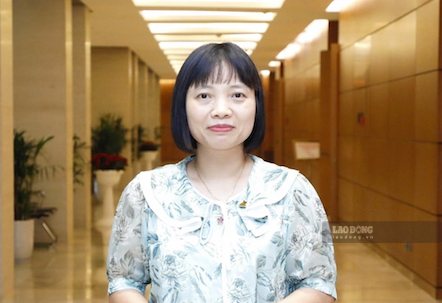
To clarify the issues raised, from the goal of streamlining the apparatus to ensuring the quality of education, Lao Dong Newspaper exchanged with Ms. Nguyen Thi Viet Nga - Deputy Head of the National Assembly Delegation in charge of Hai Phong City, Member of the National Assembly's Committee for Culture and Society.
School restructuring for the benefit of learners
According to you, what are the advantages and challenges that the education sector may face in this arrangement?
- First of all, it is necessary to recognize that this is not simply a school merger to reduce the number of focal points, but a process of restructuring the public education network in accordance with the two-level local government model, population size, population distribution and new development space.
The biggest advantage is that this policy is placed in the overall revolution to streamline the organizational structure and implement Resolution No. 71-NQ/TW of the Politburo on breakthrough development of education and training. After the process of arranging administrative units, many localities have conditions to review the school network that is still small, fragmented, and overlapping in terms of management apparatus.
The formation of schools with reasonable scale, with main schools, branches and school sites, can help reduce management levels, focus investment resources, and better use facilities, teaching staff, teaching equipment and budget. An educational institution with a sufficiently large scale also has conditions to organize strong professional groups, strengthen digital transformation, improve management capacity and create a richer learning environment.
However, the challenges are also very large, first of all the progress pressure when the completion time is close to the new school year. If the survey is not thorough, the arrangement plan may increase the distance to school, travel costs, class size or create very large schools but management capacity cannot keep up. Difficulties will be clearer in mountainous areas, islands, sparsely populated areas, isolated areas or places where transportation infrastructure is not favorable.
Besides, there is the consolidation of data, finance, assets, student records; handling redundant facilities; arranging management staff, teachers and staff; unifying operating regulations and stabilizing team psychology.
Therefore, I believe that the 30% reduction rate must be understood as a common goal, not a uniform division for all areas. Where the merger reduces access to education or affects quality, there must be flexible plans, even keeping the necessary school sites. Successful arrangement must make the system operate better, not just shorten the list of units.
In the process of school merger, what criteria need to be supervised?
- It is necessary to build a comprehensive impact assessment criteria set, which includes at least four key groups of issues.
The first group is the right to access education for students. It is necessary to specifically assess the distance, time and level of safety on the way to school; travel costs; the ability to organize semi-boarding, pick-up and drop-off; the risk of students dropping out of school or not going to class fully. Special attention must be paid to preschool children, primary school students, students with disabilities, students from poor households, students in mountainous areas, islands and difficult traffic areas.
The second group are conditions to ensure the quality of education. It is necessary to monitor class size, classroom area, functional rooms, toilets, clean water, teaching equipment, digital infrastructure, semi-boarding conditions; teacher ratio per class and teacher structure by subject. It is impossible to let after the merger, schools become overloaded, classrooms are too crowded, teachers have to move continuously, or students study in facilities that are not safe.
The third group is the legitimate rights and interests of the team. It is necessary to publicize the criteria for arranging management officials, teachers, and staff; ensure the correct job position, capacity, expertise, circumstances and legitimate aspirations; fully implement salary and allowance regimes, reserve positions and policies for those affected. All decisions related to personnel must be transparent, have dialogue and a mechanism to resolve recommendations.
The fourth group is the efficiency of management and use of resources. It is necessary to assess whether the post-arrangement apparatus really reduces intermediaries or only combines names; is the responsibility of principals and heads of branches clear; are assets, land, budget and data managed uniformly and effectively.
Each arrangement project must have an impact assessment report before deciding and a set of indicators to monitor after operation. It is necessary to publicize the plan for teachers, parents and people to contribute opinions. Supervision must go into the final result: Do students study better, do teachers have better working conditions, and are investment resources used more effectively.
Reducing titles does not mean increasing administrative work for teachers
The new policy aims to reduce education management staff and increase direct teaching staff. According to you, what conditions are needed for the arrangement to truly improve the quality of education?
- The policy of reducing management staff and increasing direct teaching staff is the right direction, because the resources of the education sector must be maximally prioritized for core activities such as teaching and learning. However, the important thing is to restructure the staff based on job positions and actual needs, and should not simply understand that just reducing one management staff member can immediately transfer one staff member to become a teacher.
The first condition is to have an accurate teacher demand map to each school, each level of education, each subject and each area. Currently, the situation of teacher shortage is often localized. Therefore, after the merger, localities must review the scale of students, number of classes, teacher norms and forecast school population fluctuations over many years, thereby mobilizing, recruiting and targeted additional training.
The second condition is to clearly distinguish administrative management from professional management. Simplifying the number of principals and vice principals is necessary, but schools with large scale, many branches and school sites pose more complex management requirements. Therefore, it is necessary to clearly design a decentralization mechanism, responsibilities of heads of school sites, professional groups and support departments; apply digital management systems to reduce records, reports and administrative work for teachers. It is impossible to reduce management titles but push all administrative work down to teachers, causing teachers to have less time for their profession.
The third condition is to ensure facilities and working conditions. The arrangement of teachers to teach inter-school or between branches is only feasible when the distance is reasonable, there are means, support regimes and scientific timetables. For difficult areas, there needs to be official residences, policies to attract and retain teachers, in accordance with the Prime Minister's direction on arranging sufficient staff and investing in official residences for teachers.
Finally, the budget saved from reducing management units must be quantified and prioritized for reinvestment in classrooms, teachers, equipment, libraries, digital transformation and student support. If only reducing the apparatus but not converting saved resources into quality education, the goal of the arrangement has not been achieved. The ultimate measure is not how many titles can be reduced, but whether teachers have more time and conditions to teach better, and students can study in a better environment.
Thank you very much, madam!


