
Domestic rice prices
The rice market on April 8 recorded a quiet development in many localities in the Mekong Delta region as purchasing demand has not improved, and in some places there is a trend of price adjustment downwards in late-season shipments.
In Bac Lieu, new rice transactions are slow, most traders temporarily stop buying, and some cases propose adjustments to reduce high offering prices. In Long An, the volume of transactions is not large, and the price level remains stable. In An Giang, the volume of rice at the end of the field is limited due to that most of the area has been deposited in advance. Meanwhile, in Dong Thap, farmers offer small quantities, and the market in general is still quiet.
According to updates from the Department of Agriculture and Environment of An Giang province, fresh rice prices today continue to remain stable compared to the previous session. Specifically, OM 5451 rice fluctuates at 5,400 - 5,600 VND/kg; Dai Thom 8 rice is at 5,600 - 5,750 VND/kg; OM 4218 rice reaches 6,200 - 6,400 VND/kg; OM 34 rice is about 5,100 - 5,200 VND/kg; OM 18 rice is at 5,700 - 5,800 VND/kg; IR 50404 rice fluctuates at 5,400 - 5,500 VND/kg.
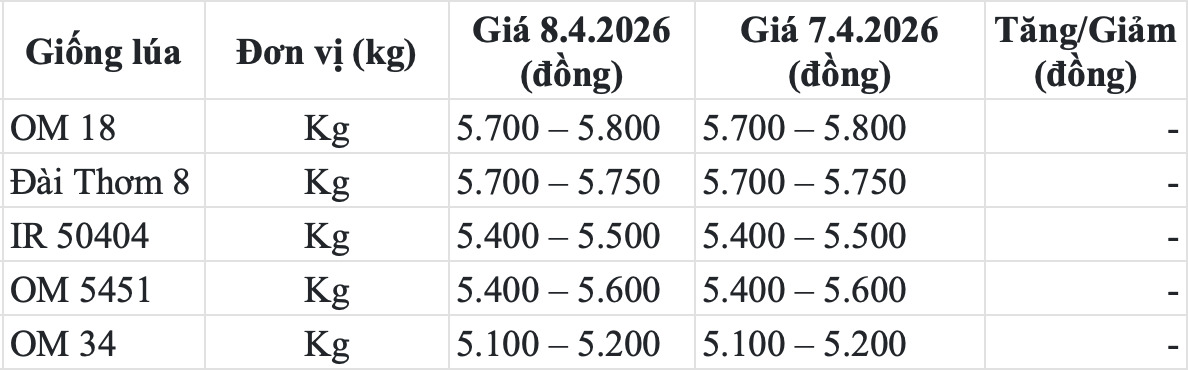
Fresh rice prices increased slightly in some localities when entering the early harvest season. However, the price of raw rice continues to be flat, reflecting that the market is still in a correction phase and purchasing demand has not increased sharply.
Domestic rice prices
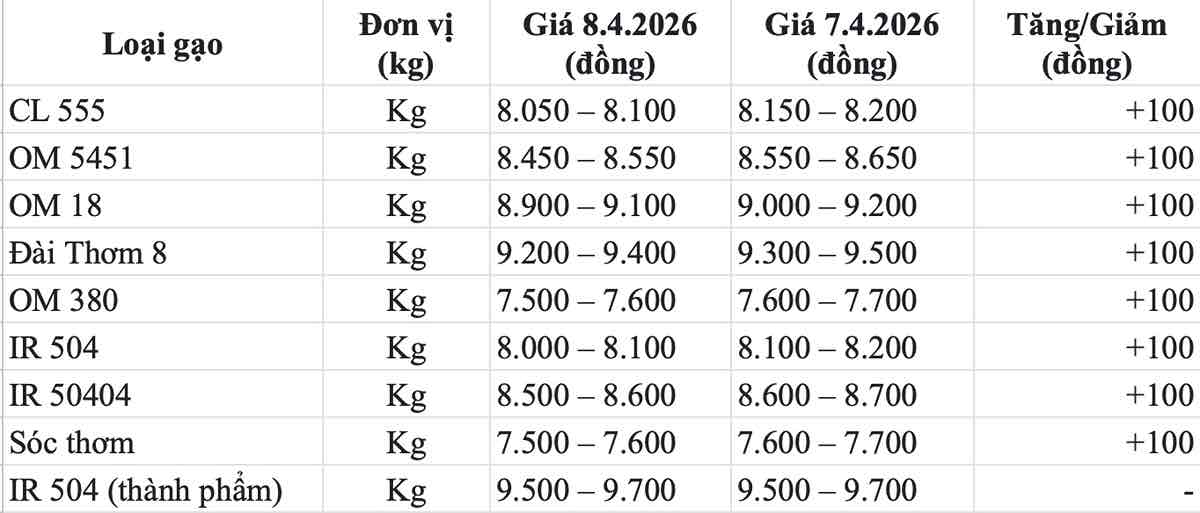
According to records on April 8, in the Mekong Delta region, the price of raw rice increased by 50 - 200 VND/kg compared to yesterday's session. Specifically, the price of raw rice CL 555 increased by 100 VND/kg, to 8,100 - 8,200 VND/kg; OM 5451 rice also increased by 200 VND/kg, trading at 8,650 - 8,750 VND/kg;
However, OM 18 rice is kept at 8,900 - 9,100 VND/kg; Dai Thom 8 fluctuates at 9,150 - 9,450 VND/kg; OM 380 at 7,500 - 7,600 VND/kg; IR 504 rice fluctuates from 8,000 - 8,100 VND/kg; IR 50404 is currently at 8,500 - 8,600 VND/kg; Fragrant peanuts with prices from 7,500 - 7,600 VND/kg; finished IR 504 rice fluctuates at 9,500 - 9,700 VND/kg.
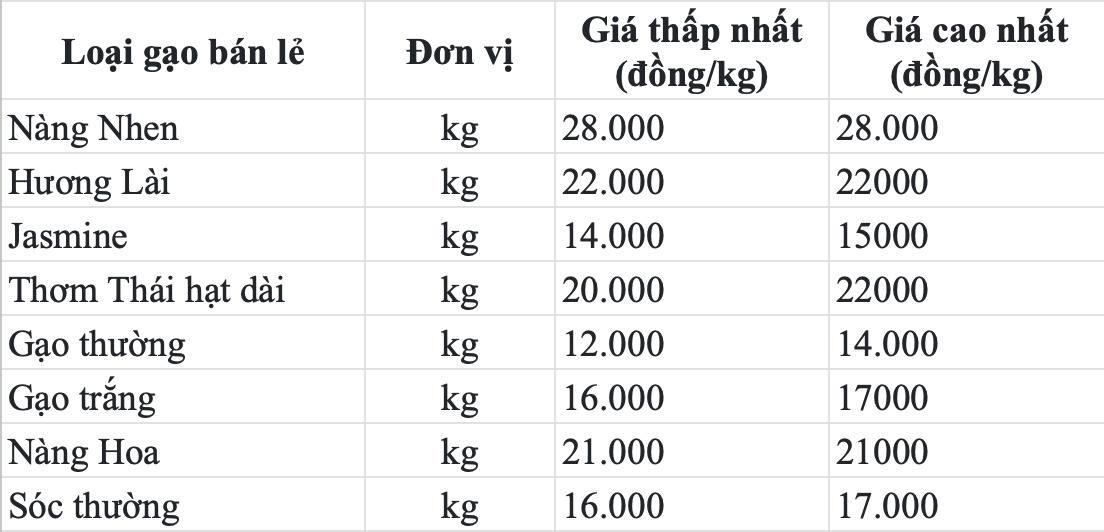
At retail markets in An Giang province, retail rice prices generally do not fluctuate much. Currently, Nang Nhen rice has the highest level of about 28,000 VND/kg; Huong Lai rice 22,000 VND/kg; Thai long grain fragrant rice fluctuates from 20,000-12,000 VND/kg; Nang Hoa rice about 21,000 VND/kg; Taiwan fragrant rice 20,000 VND/kg; common white rice about 16,000 VND/kg.
Export rice price
In the export market, Vietnam's export rice prices today (April 8, 2026) continue to maintain competitiveness compared to Thailand and India. However, in the context of volatile global food markets and increasing transportation costs, export activities are facing many new challenges as output increases but turnover has not improved correspondingly.
According to data from the Thai Rice Exporters Association (TREA), the price of 5% broken white rice in Thailand is currently stable at about 384 USD/ton.
In Vietnam, the price of 5% broken white rice fluctuates in the range of 361 – 365 USD/ton, while Jasmine rice maintains at 431 – 435 USD/ton. With Pakistan, the price of 5% broken white rice is at 344 – 348 USD/ton. Meanwhile, 5% broken white rice of India continues to be the lowest in the group of major exporting countries, fluctuating at 335 – 339 USD/ton; 5% broken rice is at 344 – 348 USD/ton.
According to a report by the USDA Foreign Agricultural Service (USDA FAS), Thailand's milled rice production for the 2026–2027 crop year is expected to reach about 20.3 million tons, down 2% compared to the previous crop. The main reason is that the area of off-season rice has shrunk from about 2.1 million hectares to 1.9 million hectares amid water scarcity risks and the possibility of El Niño returning in mid-2026.
In terms of consumption, Thailand's domestic demand is forecast to remain at about 12.4 million tons thanks to the recovery of the tourism industry. However, exports are expected to reach only about 7.3 million tons, lower than in previous years due to the impact of the stronger Baht, increased logistics costs and increased competition from India, Vietnam and Pakistan.
In that context, Vietnam's export rice prices still maintain a relative competitive advantage in the region. However, export enterprises need to continue to closely monitor the developments of the international market, especially the fluctuations in transportation costs, food reserve policies of major importing countries and competitive pressure from large-scale suppliers around the world.


