
According to a veteran analyst, world gold prices may still climb high, but there is a risk of many years of adjustment ahead, enough to "respectively" reshape profits after 2026.
After a nearly decade-long breakout, gold prices are facing a major decline. Avi Gilburt - veteran technical analyst, founder of market analysis platform ElliottWaveTrader - said that the current increase is not the beginning of a new cycle, but the end of a very long cycle formed from the bottom period of 2015-2016.
This is not the starting point. We are most likely in the final stages of the cycle, Gilburt stressed.
According to Mr. Gilburt, the gold rally stems from the "reconstruction" after 2015, when ETFs were sold off strongly and investors turned their backs on precious metals. That cycle has now lasted for nearly a decade and is showing signs of fatigue.
He predicted that 2026 will likely mark the peak of the long-term cycle of gold, before the market enters a period of decline that has lasted for many years. This assessment shocked many investors who still consider the precious metal a sustainable "shelter".
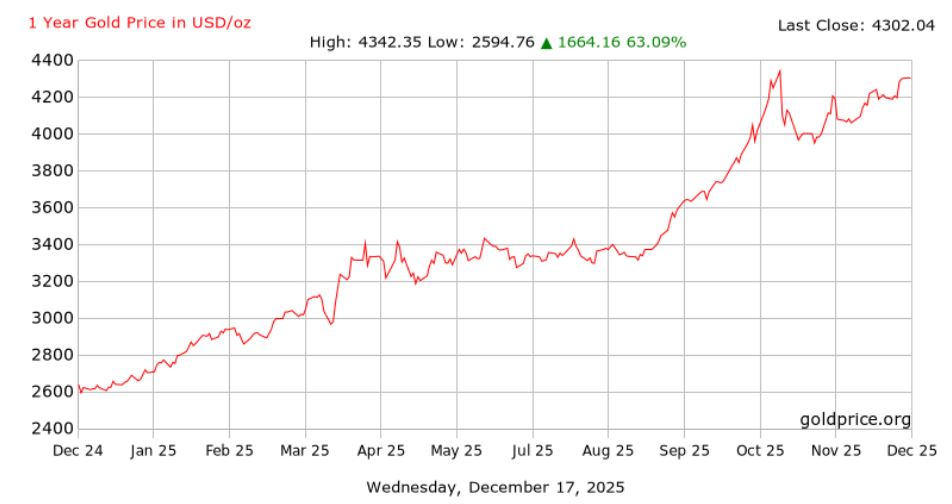
At present, world gold prices are trading around the new support zone of over 4,300 USD/ounce. According to Mr. Gilburt, the short-term fate of the market depends on the key resistance level at 4,383 USD.
If it cannot overcome, gold could see a strong correction, even falling back to $3,800/ounce.
If it breaks out completely, gold prices could get close even though they are uncertain to reach the psychological mark of 5,000 USD/ounce.
Regardless of the scenario, Mr. Gilburt believes that the final increase will be a "sprint" before the market reverses. In the long term, he does not rule out the possibility of gold prices returning to the $2,000/ounce zone in the next few years.
A profound adjustment does not mean an end. If gold falls to $3,800, it could even be a great buying opportunity for the final rally, he said.
Mr. Gilburt's forecast for the $2,000/ounce price range goes against popular view, as many experts still believe that gold prices will maintain an upward trend until at least 2026, thanks to inflation, public debt and geopolitical instability.
However, Gilburt frankly denied the role of macro stories: The fundamental element is not really important. They often just coincide with price movements.
He cited the period after 2011: Despite favorable supply and demand and loose monetary policy, gold prices have continued to decline for many consecutive years. Even the role of "hiding" is not always right.
What did gold do in 2008? It lost more than 30% of its value while stocks collapsed, he asked.
In addition to the precious metal, Mr. Gilburt also saw black clouds in the broader financial market. He believes that long-term bonds have reached a peak, yields may increase sharply in the second half of this decade, even accompanied by a major collapse of the stock market.
Analyst Gilburt stressed that he did not call for gold to be left. The important thing is to understand the market position in the cycle. The coming months may still bring opportunities. But after 2026, the risk- profit balance may change completely.
The world gold price at 16:33 on December 17, Vietnam time, was trading at 4,318.15 USD/ounce, up 16.44 USD, equivalent to an increase of 0.38%.
Domestically, the price of SJC gold bars is trading around 154.2 - 156.2 million VND/tael (buy - sell). The price of 9999 Bao Tin Minh Chau gold rings is trading around 152.2 - 155.2 million VND/tael (buy - sell).


