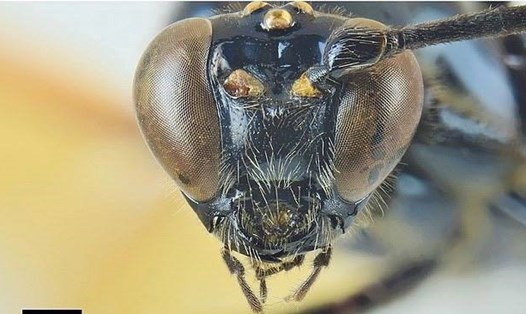
According to research published on August 24 in the journal the Royal Society Interface, the discovery was accidentally discovered by a group of scientists while searching for unknown fluorescent insects in a tropical forest in northern Vietnam.
"We were surprised to discover such a strong biochemical substance containing fluorescent. To my knowledge, this phenomenon has never been observed in the past, by scientific researchers or any photographer," said author and chemistry professor Bernd Schöllhorn at the University of Paris.
The beehives are made from many small, hexagonal cages joined together, built by some species of paper-plowing bees, all of which belong to the Polists.
The top of the hexagonal oval cavities is covered with a type of hood made from soft fibers, which protects the developing bee butterflies inside. Scientists have discovered that these picky hats produce strong blue light when exposed to UV rays with wavelengths ranging from 360 to 400 nanometers.
When exposed to white light, the beehive's hood is bright. The authors wrote in their report that the fresh blue fluorescent light of the beehive begins to appear under normal daylight and at night under UV light, the beehive turns brilliant green that can be seen from a distance of 20m.
The authors have compared the nests of these Vietnamese Laurel wreaths to the nests of two other Polists - one from the Amazon tropical forest in Guiana in France and the other from the southern moderate region of France. They found that all plow beehives have similar fluorescent properties, although their brightness is slightly different.
Explaining the invention, scientists say that the flowering beehives act as lanterns, signaling the plow bees to fly back to their nests during theirang, or to distinguish the beehives from the nests of nearby nests. Another possibility is that fluorescent hoods help protect plow insects from harmful UV rays, which can disrupt the development of insects.
Previous studies have shown that the development of pi nan insects is greatly affected by the relative length of day and night. Therefore, brightly glossed pork hats can help control the amount of daylight reaching the larvae as they develop into losses, the research authors said.
Polistes bees in Vietnam usually breed during the rainy season, from June to August. During this time, the cloudy sky significantly blocked the light from reaching the cluster but still allowed some UV rays to pass through.
The authors wrote in the report that, by making the hoods glow, this remaining violet beam light can increase the amount of contact light of the plowing insect, thereby affecting how they develop.
In future research, the authors plan to analyze the chemical composition of fluorescent compounds in pi nan nests to see if they can be usefully applied in the field of biology and medicine.