
From January 1, 2026, China will apply stricter control measures to silver exports, expanding the scope of management from rare metals to a metal once considered "normal" in the global commodity market.
According to analysts, this move could create widespread consequences for US industry and defense - areas heavily dependent on silver supply.
China's move quickly attracted reactions from the international technology and financial circles. On social network X, Tesla CEO Elon Musk frankly said: "This is not good. Silver is a necessary material in many industrial processes.
In fact, control measures are not a surprise decision. The Chinese Ministry of Commerce announced a new management framework in October last year, amid Beijing's increased monitoring of strategic metals.
Earlier last month, China announced a list of 44 businesses licensed to export silver in the period 2026-2027 under the new mechanism.
Not only silver, the regulations from 2026 also tighten tungsten and antimony - materials that China holds the controlling supply chain and is widely used in defense as well as advanced technology.
Although Beijing has not announced a wide ban on silver exports, Chinese state media quoted a source in the industry as saying that the new policy has officially "upgraded" silver from ordinary goods to strategic materials, placing it in the same management framework as rare earths.
This means that silver exports will be subject to much stricter supervision and licensing than before.
The impact of the policy has soon spread to the international business community. The EU Chamber of Commerce in China said that in a quick survey in November, most member businesses have been or are expected to be affected by China's metal export control measures.
In the opposite direction, the US also takes defensive steps. In November, Washington put silver on the list of important national-level minerals, with the reason that this metal plays an essential role in circuits, batteries, solar panels and antibacterial medical devices.
A separate US analysis shows that China is one of the largest silver producers in the world in 2024, and also possesses top reserves.
According to data from Wind Information, in the first 11 months of the year, China exported more than 4,600 tons of silver, while imports were only about 220 tons - reflecting this country's overwhelming position in the global market.
Export restrictions were introduced right at the time when silver prices rose sharply. According to CEO David Stein of Kuya Silver (Canada), in recent weeks, two Chinese businesses have contacted to buy physical silver at prices about 8 USD/ounce higher than the market. An Indian customer is even willing to pay up to 10 USD/ounce higher.
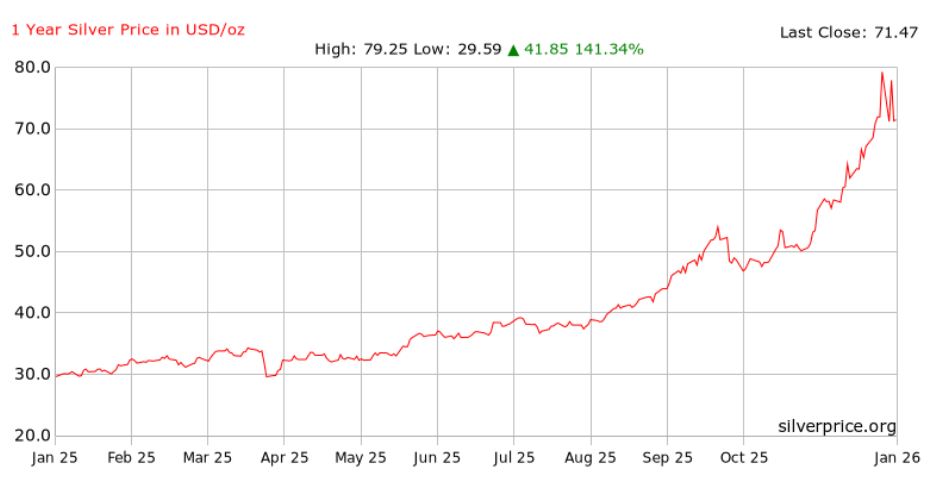
Silver prices have more than doubled in 2025 - the strongest increase since 1979, when the metal once increased by nearly 470%.
Although the price adjusted slightly after surpassing the record mark of 80 USD/ounce, the silver price still traded around 74 USD/ounce on January 2.
Gold prices also increased by more than 60% since the beginning of 2025, currently trading around 4,383 USD/ounce.


