
Gold has experienced a sharp rally in the past 5 years, soaring by more than 170%" - Kriti Gupta, CEO of J.P. Morgan Private Bank, and Justin Biemann, Global Investment Strategist, wrote - "There are many reasons, but the biggest driver may be the new era of geopolitical instability and global fragmentation, causing investors to turn to precious metals.
Let's add concerns about currency devaluation, growth, inflation and irresponsible fiscal policy - factors that have not been fully reflected in sovereign assets. It is not difficult to understand why gold has become a popular asset in times of tension," they said.
In major geopolitical shocks, gold achieved an average yield of 1.8% and a neutrality of 3.0%, surpassing many other types of assets.
If gold usually performs well in the context of geopolitical instability, and these instabilities are not showing signs of ending soon, the question is: What can stop the rise of gold?
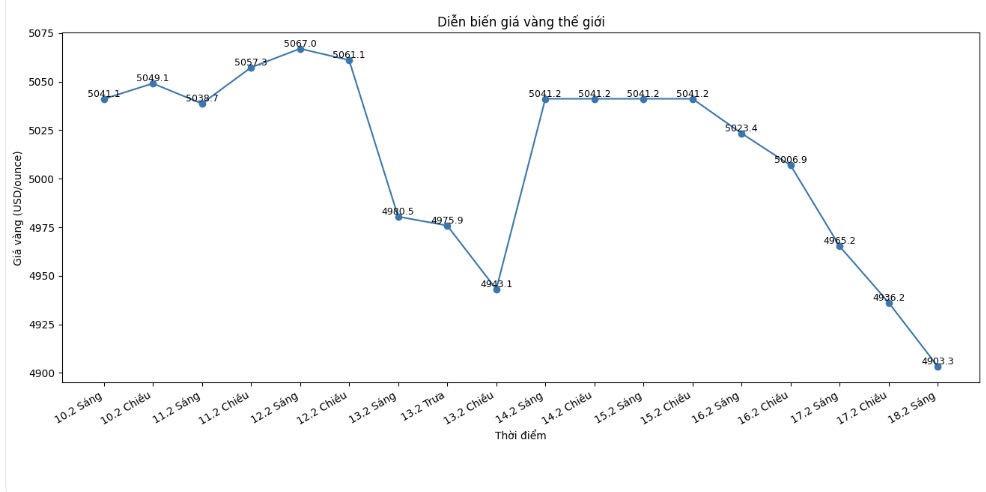
Gupta and Biemann mentioned two main risks:
Central banks may stop buying gold
The biggest driver of gold prices is central banks. Net buying has doubled since the Russia-Ukraine conflict broke out in 2022. Central banks are stepping up gold purchases to diversify reserves and reduce dependence on the USD after the US freezes Russian assets," they wrote.
The two authors noted that, in addition to the IMF, the 5 largest gold holders are the US, Germany, Italy, France and Russia. "What happens if structural demand from central banks weakens? Or worse, if they sell gold?
According to them, this scenario once occurred. "In the period 1999-2002, the United Kingdom organized a public auction, selling more than 50% of its gold reserves to switch to holding foreign currency. At the same time, Switzerland abolished the franc-gold linkage. Gold prices fell 13% in 3 months after the UK's announcement - equivalent to a decrease of about 650 USD at current prices.
Gold sales only stopped after central banks signed the Washington Agreement on gold, to coordinate and limit large sales. This agreement expired in 2019, when the trend shifted to buying.
Although in theory, sales can still occur, but this possibility is very low, at least in the near future.
Why is it difficult for central banks to sell gold?
By 2025, gold accounts for about 19% of the reserves of emerging economies, compared to 47% in developed countries," they said.
In the strong buying group, China stands out. Although it is the 7th largest gold holder in the world, gold accounts for only 8.6% of its reserves. "If the trend continues, China still has more room to buy more. Not only China, Poland, India and Brazil also contribute to promoting structural demand.
For G-10 central banks, there are no signs of gold sales plans. "Even for the Fed, gold sales require major legal changes and break a century-long precedent.
A survey by YouGov/World Gold Council in 2025 shows that 95% of central banks expect global gold prices to increase, 5% believe they will remain unchanged and no opinion predicts a decrease.
Individual investors may withdraw from gold
Individual investors cannot be ignored" - Gupta and Biemann commented - "They are also pouring money into gold to hedge geopolitical risks and macroeconomic instability.
However, this group may quickly abandon gold if risks decrease or other hedging channels appear. "The last fluctuation in January is a clear example: Gold increased by 20% in a week and then fell sharply in just two days.
However, they assess the level of participation of individual investors today as "high but not unusual". The amount of gold held through ETFs is about 100 million ounces, equivalent to 8% of the world's central bank gold, still lower than the record level of 2020.
The long-term role of gold
In December, J.P. Morgan Global Research forecast that new demand from Chinese insurance companies and the cryptocurrency community could push gold prices up in 2026.
The upward momentum of gold is not going in a straight line, but the trends supporting higher price levels are still not over," said Natasha Kaneva - Head of Global Commodity Strategy.
Factors such as the weakening USD, falling US interest rates, along with economic and geopolitical instability continue to be positive drivers for gold.
J.P. Morgan forecasts that gold demand from central banks will average 585 tons per quarter in 2026.


