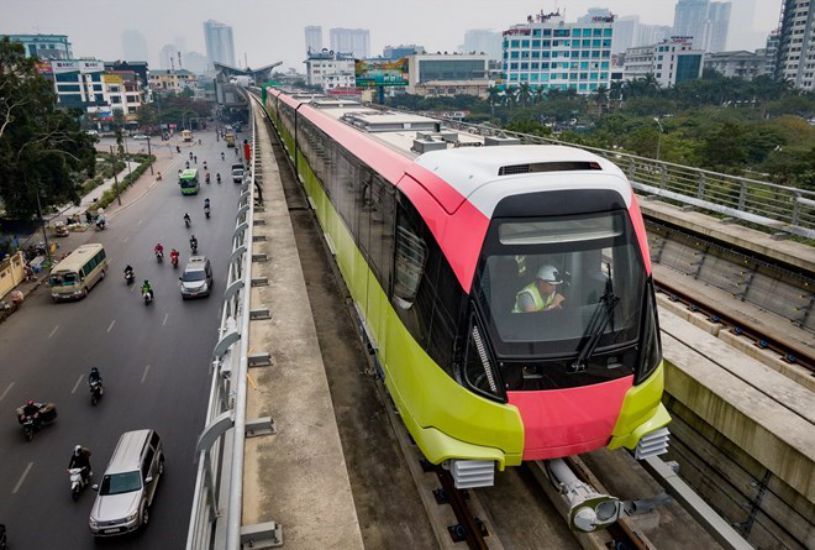
Huge demand for human resources for railway projects
Modern railway projects in Vietnam are opening up unprecedented demand for human resources. According to calculations by Vietnam Railways Corporation (VNR), the Lao Cai - Hanoi - Hai Phong railway line alone needs about 2,431 personnel for management, operation, exploitation and maintenance, belonging to 13 different job title groups. Of which, there are about 1,700 workers directly serving the operation and maintenance of the system.
These positions not only include train drivers or train dispatchers as before, but also many new positions related to modern technology such as electromechanical engineering, signal information, power supply, vehicle inspection and repair.
On a larger scale, the North-South high-speed railway project is considered the largest infrastructure project in Vietnamese history, with a total length of more than 1,500km. Experts predict that this project could create more than 200,000 jobs, from project management, design consulting to operation, equipment manufacturing and construction.
Recently, SGC Investment and Construction Joint Stock Company - General contractor for the construction of high-speed railway and infrastructure, road tunnels,... projects in Vietnam announced the recruitment of 25,000 personnel throughout the system. Including 15,000 high-quality personnel for infrastructure construction lines and 10,000 personnel for two high-speed railway lines Hanoi - Quang Ninh and Ben Thanh - Can Gio.
This figure shows that human resources are no longer just a story of the railway industry, but have become a problem for the entire labor market in the fields of construction, mechanics and technology.
Attractive mode
The development of railway projects also opens up many attractive career opportunities for workers.
At SGC, engineers have incomes from 30 - 55 million VND/month (depending on the position); workers have incomes from 22 - 29 million VND/month (depending on the position). Drivers and mechanics have incomes from 16 - 65 million VND/month (depending on the position). Businesses commit to paying on time. Salaries are paid periodically on the last day of the month.
In addition, workers are fully participating in social insurance, health insurance, unemployment insurance and work accident insurance 24/7 right from when they are present at the construction site, along with annual leave regimes, Tet gifts... - a rare policy in the current construction market.
This income level is considered competitive compared to many other technical occupations, especially when accompanied by insurance and occupational safety regimes at large construction sites. This also creates a new trend in the labor market: many young engineers are starting to pay more attention to infrastructure and transportation industries - areas that were previously less noticed.
Human resource quality requirements
If traditional infrastructure projects mainly require construction labor, modern railway projects require completely different skills. According to experts, high-speed railways are a system that integrates many complex technologies: from precision mechanics, electrical - electronics, automation to artificial intelligence in traffic management. Therefore, the human resources team not only needs to be large but also must be well-trained and capable of mastering technology.
Assoc. Prof. Dr. Nguyen Van Hung - Rector of the University of Transport - said that modern technology is only a necessary condition, and the decisive factor lies in people. Without a team of qualified engineers, Vietnam will have to depend on foreign contractors and experts for a long time.
Representatives of the construction management agency emphasized that the high-speed railway project is not only a transportation project, but also a test of Vietnam's science - technology capacity and human resources.
Mr. Le Trung Thanh - Director of the Department of Science and Technology (Ministry of Construction) said: "The high-speed railway is the largest project ever. The most important thing is human resources from design, construction, operation, equipment manufacturing to standard and regulation management.
According to Mr. Thanh, besides learning from the experiences of France, Korea or China - countries that have developed thousands of kilometers of high-speed railways, Vietnam must pay special attention to training a generation of young engineers.
Challenges from training to attracting talent
However, one of the major issues today is the gap between the human resource needs of projects and the training capacity of educational institutions.
The training time for a specialized railway engineer usually takes at least 5-7 years, while many large projects are expected to start in the next few years. This makes the preparation of human resources urgent.
The government has set a target to train at least 35,000 high-quality human resources in the railway sector in the period 2025 - 2030, including 1,000 postgraduate graduates, 14,000 university graduates and tens of thousands of human resources at other levels.
In parallel with that, about 88 million USD from the project budget will be dedicated to training, including scholarships for students in specialized fields such as mechanics, automation, artificial intelligence and building laboratories for research.
However, universities believe that attracting students to specialized engineering majors is still a difficult problem. Many majors such as railway engineering, mechanics or materials often have a lower number of applicants than economics or information technology majors.
At the seminar to gather opinions on the draft Standard program for university-level training in railways organized by the University of Transport on March 11, Mr. Dang Van Huan - Deputy Director of the Higher Education Department (Ministry of Education and Training) said: It is necessary to build a human resource capable of receiving and developing new technologies. Therefore, standardizing the training program is an important requirement, creating a basis for schools to implement training, while ensuring transparent competition and improving the quality of human resources. At the same time, there needs to be a scholarship mechanism, training orders from businesses and good remuneration policies to attract good students to study these fields.