
Loyal friends
In the rapid transformation of educational technology, when artificial intelligence is present in each lesson, the children's board is still quietly in the small pair of primary school students like a loyal friend of the beginning of learning to read and write, learning to read and write. No screen, no connection, no charging battery; just a flat panel and white pollen tree, but many generations of students still grow up with it, so durable and useful that it is difficult for any equipment to replace it.
Children's board - only small size A4 or A3 - helps children practice literacy, Math, and spelling right in class and at home. On top of that, the still-shy characteristics and the still-missing calculations gradually become a journey of training: from memory to presentation, from observation to logical thinking. For primary school children, the children's board is not just a board; it is a "minimize lab", where they try - make mistakes - correct - understand in safety and excitement.
In the learning toolkit, the children's table is simple but has high practical value, especially for Math. Every time the teacher asked to "raise any board!" more than thirty boards were raised simultaneously as living signals. In just a few seconds, the teacher could see how much the class grasped the lesson, who understood it quickly, who was confused. That direct interaction creates a natural, time-saving learning rhythm while still being close to each student - something that even smart software can find difficult to fully implement.
For students, the small group trains in calculation skills, presentation skills, the habit of self-correcting mistakes and especially the ability to criticize delicately through commenting on your exam. These seemingly simple operations build the foundation for independent thinking - the most necessary quality of learners in the digital age.
Steeped in memory
For teachers, the children's group is an "immediate data file" to assess the whole class's abilities in a very short time, thereby adjusting methods and differentiating learning tasks scientifically. To promote the children's book effectively, teachers need to orient the lesson format, choose the time of use, regulate how to raise the book, commenting, and at the same time ensure that the book is in accordance with standards, with a pen and felt, and a hand sanitizer to keep the children.
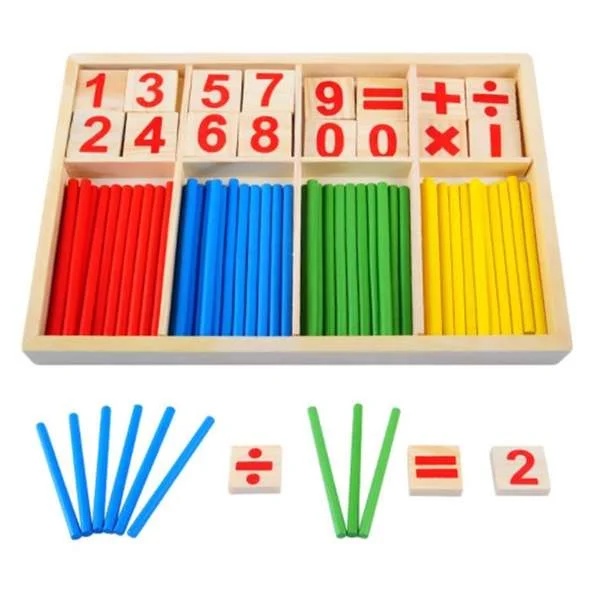
But the children's group is only half the story. The other half is in red green balls, wooden planks, round stones... small objects that help children "touch in knowledge".
On the first day of school, the concept of two plus three is equal to one year for children is just a sound. But when she placed two blue balls next to three red balls, then counted slowly: "one, two, three, four, five"... the combination suddenly became clear as the sunlight passing through the classroom doorstep. From those concrete objects, the young intelligence is led into the abstract world - where numbers and rules begin to form.
Primary education cannot be rushed. It is like teaching children to swim: let their feet get used to the water before releasing themselves into the middle of the flow of knowledge. When children operate with calculation, group balls or divide the cake, their brains are not only calculating but are building a "thinking model" - an underlying map that helps them understand the logistics of life. Jean Piaget - a Swiss psychologist - once said: "Children do not learn by listening to others, but by acting and thinking for themselves".
Then one day, the balls will leave the desks. Que tinh will return to the closet. At that time,culation was in memory, there was no need for real things to explain. The rise of abstract thinking - that is the sign of intellectual maturity. But that journey cannot be shortened. Without a specific stage of operation, children can easily quickly learn and do the right thing without understanding the nature.
Therefore, primary school teachers grasp the art of transfer: from real things to concepts, from concrete to abstract. Each lesson is a bridge - the bridgehead is the young world living, the end of the bridge is the world of young knowledge will enter.
In the AI era, baby boards, spurs, balls... are not "replaced" by technology, but are supplemented by technology. One side is used to build a foundation, the other side is used to expand. The foundation must be solid for the top to be high. Displayboards can take children to an endless store of knowledge, but the childboards and those small objects help children set their first steps firmly.
Those simple tools will then be traced back to memories, but their traces are forever: in logical thinking, in confidence, in self-study habits. They are the "silent teachers" of their childhood - silent but persistent - so that when they grow up, every child can smile and remember: the journey to knowledge begins from very small things.


