
According to the latest storm news from the Philippine Atmospheric, Geophysical and Astronomical Services Administration (PAGASA), at 10:00 AM on February 5th, the center of Typhoon Basyang was located at about 8.0 degrees north latitude, 125.0 degrees east longitude, about 295km east of Hinatuan town, Surigao del Sur province.
The strongest wind near the storm center is about 65 km/h, gusting 80 km/h and is moving west-southwest at a fairly fast speed, about 25 km/h.
Along with accelerating, Basyang also forced PAGASA to raise the wind warning level.
Wind signal No. 2 has been issued in 10 provinces, including Surigao del Norte, Surigao del Sur, the northernmost Davao Oriental area, Agusan del Norte, Agusan del Sur, Camiguin, Misamis Oriental, the northern Bukidnon area, northeastern Lanao del Norte and northeastern Misamis Occidental.
Wind signal number 1 is applied in about 30 other areas.
Typhoon forecasts show that Typhoon Basyang is likely to strengthen further before making landfall for the first time, likely in Surigao del Sur at the end of February 5 or early morning of February 6.
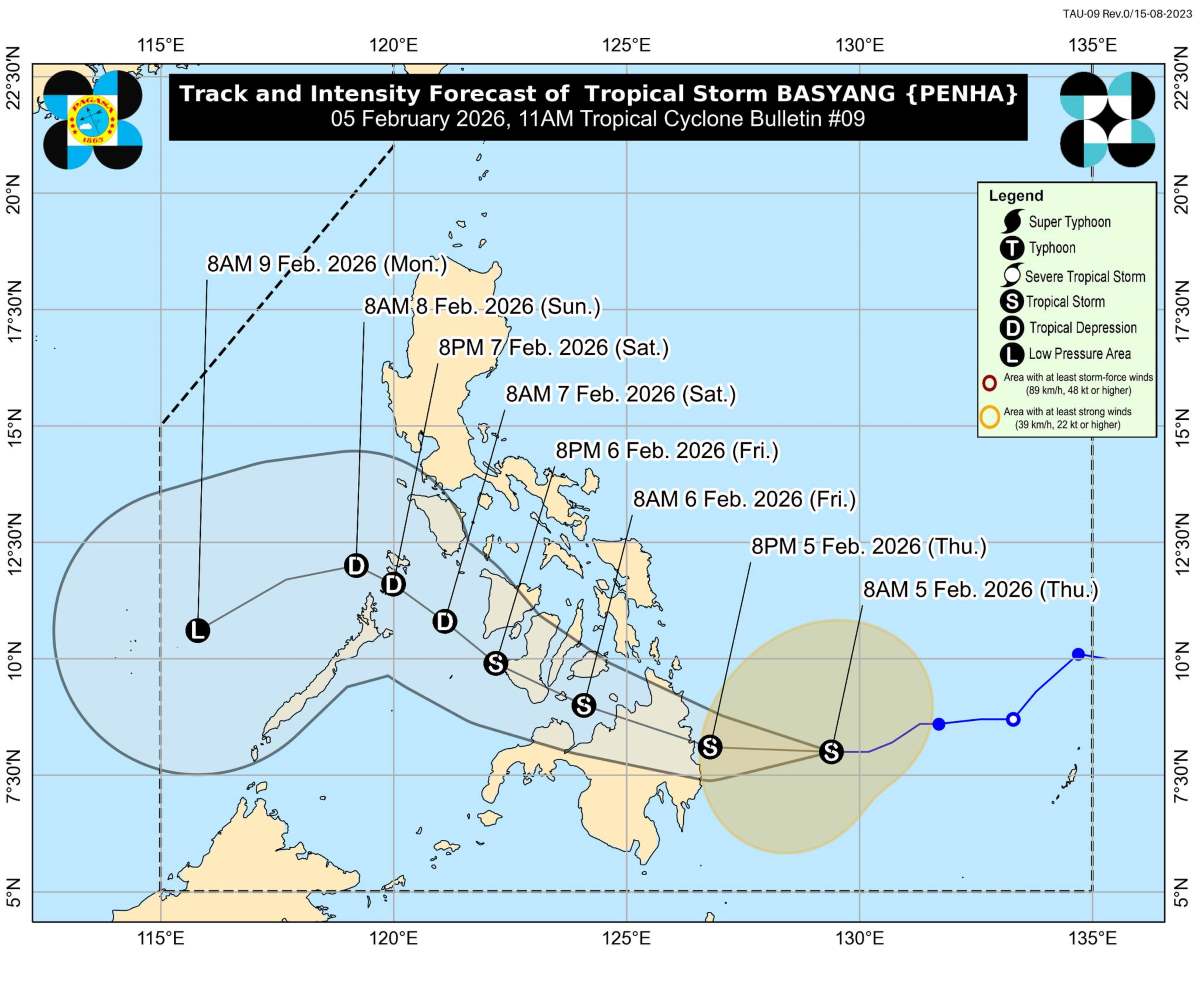
After entering the mainland, the storm is forecast to gradually weaken but still maintain tropical storm intensity when sweeping through the northeast of Mindanao, Siquijor Island and south of Negros Island until the afternoon of February 6.
When continuing to move westward, the typhoon is likely to weaken into a tropical depression before crossing the northern Palawan area in the afternoon or evening 7. 2. PAGASA said that after that, when entering the East Sea, Typhoon Basyang may weaken into a remaining low pressure area.
This is also a period that experts closely monitor to assess the impact of this weather circulation when approaching the East Sea.
Regarding weather impacts, Typhoon Basyang is forecast to cause widespread heavy rain. On February 5 and 6, significant rain will cover many areas in Visayas and Mindanao. By February 7, Mimaropa and Western Visayas will be the main areas affected by rain due to typhoon circulation.
PAGASA warns that heavy to very heavy rain is likely to occur in the northern and eastern areas of Mindanao, as well as the central and western areas of Visayas. With heavy rainfall in a short time, the risk of serious flooding and widespread landslides is assessed as very high in many areas of Mindanao, Visayas and southern Luzon Island.
Faced with the complicated developments of Typhoon Basyang, Philippine authorities recommend that people continuously monitor storm forecast bulletins, the latest warnings from the meteorological agency, and proactively implement measures to protect lives and property.
People in high-risk areas are required to strictly comply with evacuation orders when issued, in order to minimize damage caused by storms and floods.


