
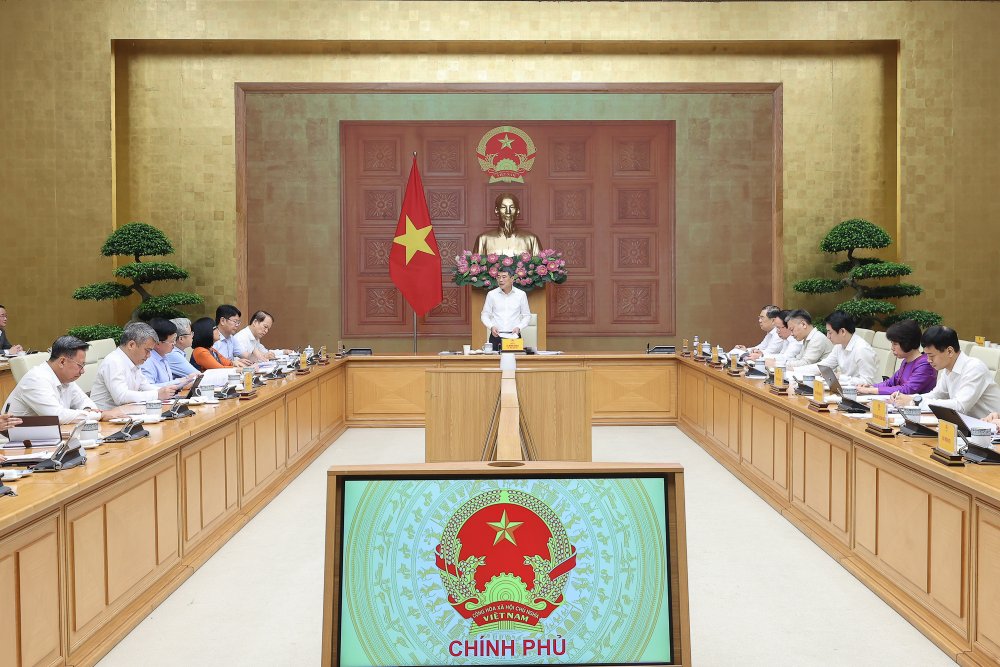
On May 11, at the Government Headquarters, Politburo Member, Prime Minister Le Minh Hung chaired a working session with the Ministry of Justice on the situation of task implementation from the beginning of 2026 to date, orientations, and key tasks in the coming time.
Concluding, the Prime Minister emphasized that, as the "legal gatekeeper" agency, strategic advisor to the Government on law-making and institutional improvement, the Ministry of Justice has a great responsibility and important role to make law and institutions truly a strategic breakthrough, serving national development and double-digit growth.
The Head of Government especially noted the work of controlling, not allowing the situation of laws waiting for guiding documents to be implemented as in the past; preventing and combating corruption, negativity, group interests, "ask-give" mechanisms in law-making work; as well as noting regulations in the online environment and digital environment.
The Prime Minister directed the Ministry of Justice to focus on building a strategic project to complete the Vietnamese legal system in the new era with a vision to 2045, and report to the Standing Committee of the Government Party Committee before October 15, 2026.
Ministries and sectors in charge of building legal normative documents must study, absorb, and fully explain the appraisal opinions of the Ministry of Justice, avoiding the situation where newly issued documents have to be amended or cannot be implemented in practice.
The Prime Minister clearly stated that the Ministry of Justice and the Government Office must carefully review the draft before reporting to the Government and the Prime Minister. If there are still different opinions, it is necessary to strengthen direct exchange with the drafting agency, "direct exchange only takes an hour to resolve very smoothly, but if a document is issued, it will not be completed for a whole month".
The Ministry of Justice is responsible for clearly affirming whether the submitted dossiers are eligible for submission or not; resolutely not submitting to the Government dossiers that are not eligible, without detailed draft documents attached.
Government leaders also requested to promote administrative reform, control administrative procedures (TTHC) and comprehensive digital transformation in the Ministry of Justice and the entire sector.
Standardize, clean up, and update data under management, ensuring that data is "correct, sufficient, clean, alive, connected, shared, and reusable"; restructure procedures, not requiring people or businesses to provide existing information.
Continue to perform well the task of controlling and organizing the review, reduction, decentralization, and simplification of administrative procedures and business conditions in accordance with Conclusion No. 18 of the Central Government and strictly control, resolutely not allowing further arising after reduction, decentralization, and simplification.
Research and develop a pilot project to evaluate and score (KPI) on administrative procedure reform of ministries, agencies, and localities.
The Prime Minister directed the Ministry to improve the efficiency of civil judgment enforcement, compliance with administrative procedure law and administrative judgment enforcement, especially the recovery of corruption and economic assets.
Identifying improving the quality of civil judgment enforcement as a key solution to release financial resources and assets in disputes, contributing to promoting economic development and ensuring the rule of law.
Regarding industry building, the Prime Minister requested to continue to consolidate the organizational structure, personnel and train high-quality human resources to advise on law-making.


